TL;DR
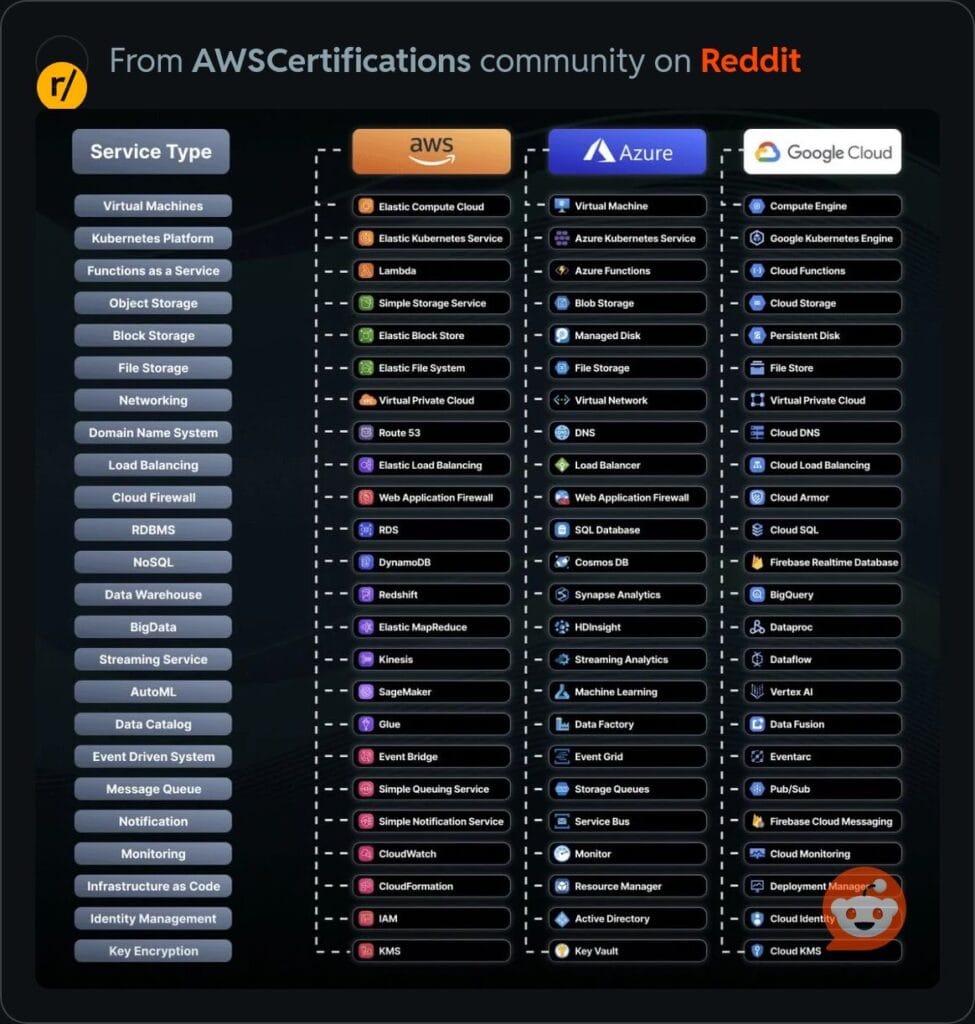
For those adopting multi-cloud strategies or planning cloud migrations, understanding the equivalent services offered by AWS, Azure, and Google Cloud is crucial. This guide provides a detailed comparison, covering compute, storage, networking, databases, machine learning, and other key services across these major cloud providers. Use this comparison to identify corresponding services and make informed decisions.
AWS vs. Azure vs. Google Cloud: Mapping Equivalent Cloud Services
Cloud adoption is growing rapidly, and Amazon Web Services (AWS), Microsoft Azure, and Google Cloud Platform (GCP) are leading the way as the top cloud providers. Whether your organization is migrating from one provider to another, managing a multi-cloud strategy, or seeking cost optimization, understanding the equivalent services across these platforms is essential.
In this blog post, we’ll break down the major service categories across AWS, Azure, and GCP, mapping their equivalent offerings to help you understand how these platforms align.
Table of Contents
1. Compute Services (Virtual Machines)
Compute services allow you to run virtual machines in the cloud.
• AWS: Elastic Compute Cloud (EC2)
• Azure: Virtual Machines
• GCP: Compute Engine
Each cloud provider offers various instance types, including general-purpose, compute-optimized, and memory-optimized, to cater to different workloads.
2. Kubernetes and Container Services
Managed Kubernetes services simplify the deployment of containerized applications.
• AWS: Elastic Kubernetes Service (EKS)
• Azure: Azure Kubernetes Service (AKS)
• GCP: Google Kubernetes Engine (GKE)
GKE is known for its native integration with Google’s infrastructure, while EKS and AKS provide strong integrations with their respective ecosystems.
3. Serverless Functions
Serverless compute lets you execute code without provisioning servers.
• AWS: Lambda
• Azure: Azure Functions
• GCP: Cloud Functions
These services support event-driven architecture, enabling you to build scalable applications with minimal infrastructure management.
4. Object Storage
Object storage is used for storing unstructured data such as images, videos, and backups.
• AWS: Simple Storage Service (S3)
• Azure: Blob Storage
• GCP: Cloud Storage
S3 is renowned for its wide ecosystem support, while Azure Blob Storage and Google Cloud Storage offer competitive pricing and deep integrations.
5. Block Storage
Block storage is essential for applications requiring low-latency access.
• AWS: Elastic Block Store (EBS)
• Azure: Managed Disks
• GCP: Persistent Disks
Each provider offers different performance tiers (SSD, HDD) for varying workload requirements.
6. File Storage
File storage services offer cloud-based shared file systems.
• AWS: Elastic File System (EFS)
• Azure: Azure Files
• GCP: Filestore
EFS is NFS-based, making it suitable for Unix-based workloads, while Azure Files integrates well with Windows servers.
7. Networking Services
Networking services manage connectivity between resources.
• AWS: Virtual Private Cloud (VPC)
• Azure: Virtual Network
• GCP: Virtual Private Cloud
All three providers offer subnets, routing, and security groups but differ in configuration approaches.
8. Domain Name Services (DNS)
DNS services map domain names to IP addresses.
• AWS: Route 53
• Azure: Azure DNS
• GCP: Cloud DNS
Route 53 includes domain registration, while Azure DNS and Cloud DNS focus on DNS management.
9. Load Balancing
Load balancing services distribute traffic across resources.
• AWS: Elastic Load Balancing (ELB)
• Azure: Load Balancer
• GCP: Cloud Load Balancing
Each platform offers Layer 4 and Layer 7 load balancing capabilities.
10. Cloud Firewalls
Firewalls provide network security by controlling incoming and outgoing traffic.
• AWS: Web Application Firewall (WAF)
• Azure: Azure Web Application Firewall
• GCP: Cloud Armor
11. Database Services
Relational Databases
Managed SQL databases.
• AWS: Relational Database Service (RDS)
• Azure: SQL Database
• GCP: Cloud SQL
NoSQL Databases
Non-relational database solutions.
• AWS: DynamoDB
• Azure: Cosmos DB
• GCP: Firestore
12. Data Warehousing
Data warehousing services support large-scale data analysis.
• AWS: Redshift
• Azure: Synapse Analytics
• GCP: BigQuery
BigQuery is popular for real-time analytics, while Redshift and Synapse are known for their data warehousing capabilities.
13. Big Data Processing
Services for large-scale data processing.
• AWS: Elastic MapReduce (EMR)
• Azure: HDInsight
• GCP: Dataproc
14. Streaming Services
Stream processing services for real-time data.
• AWS: Kinesis
• Azure: Stream Analytics
• GCP: Dataflow
15. Machine Learning and AI
Managed machine learning services.
• AWS: SageMaker
• Azure: Machine Learning
• GCP: Vertex AI
16. Data Catalog
Tools for data discovery and management.
• AWS: Glue
• Azure: Data Catalog
• GCP: Data Catalog
17. Event-Driven Architecture
Event processing services.
• AWS: EventBridge
• Azure: Event Grid
• GCP: Eventarc
18. Messaging Queues
Messaging services for asynchronous communication.
• AWS: Simple Queue Service (SQS)
• Azure: Service Bus
• GCP: Pub/Sub
19. Notifications
Push notification services.
• AWS: Simple Notification Service (SNS)
• Azure: Notification Hubs
• GCP: Firebase Cloud Messaging
20. Monitoring and Logging
Tools for monitoring infrastructure and applications.
• AWS: CloudWatch
• Azure: Monitor
• GCP: Cloud Monitoring
21. Infrastructure as Code (IaC)
Tools for automating infrastructure deployment.
• AWS: CloudFormation
• Azure: Resource Manager
• GCP: Deployment Manager
22. Identity and Access Management (IAM)
IAM services manage access to cloud resources.
• AWS: IAM
• Azure: Active Directory
• GCP: Cloud IAM
23. Key Management Services (KMS)
Encryption key management.
• AWS: KMS
• Azure: Key Vault
• GCP: Cloud KMS
24. Conclusion
Understanding the equivalent services across AWS, Azure, and GCP is essential for cloud migrations, multi-cloud strategies, and optimizing costs. This guide provides a foundational comparison that can assist cloud architects, developers, and IT professionals in making informed decisions.
25. Additional Resources
• AWS Service Overview
• Azure Services
• Google Cloud Services
This blog post offers a comprehensive comparison of AWS, Azure, and Google Cloud, helping users navigate the complexities of cloud service selection across major platforms.