OpenAI’s MCP Embrace Changes the AI Tooling Battle — But It Won’t Make Agents Easy
When a protocol starts as a niche developer convenience and then gets adopted by one of the biggest model vendors in the world, it stops being a curiosity. It becomes infrastructure. That is why a small Reddit thread celebrating OpenAI’s MCP support matters more than its modest score suggests. The news is not that one company added another integration option. The news is that the industry may be converging on a shared way to connect models to software, data, and real work.
The primary trigger for this article was a thread in r/mcp titled “OpenAI is now supporting mcp”. The post itself is short, but the reaction around it captures something important: developers see standardization as the difference between building one impressive demo and building systems they can actually maintain. OpenAI’s recent Responses API update confirmed support for remote MCP servers, while Anthropic’s original MCP announcement explains why the protocol existed in the first place. Put those pieces together and a clearer picture emerges.
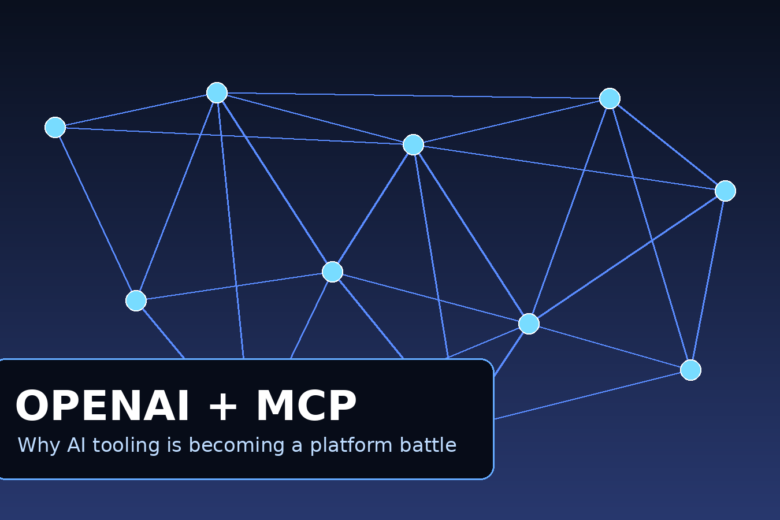
MCP is not the end of tool chaos. It is the beginning of a more serious platform fight. The companies that win the next phase of AI will not just ship the smartest models. They will make it easiest for developers to wire those models into the messy software stacks where business value lives.
Why this tiny Reddit thread is worth paying attention to
Reddit is often a better early warning system than formal launch posts. Press releases tell you what a company wants you to notice. Developer threads tell you what people think will change their work on Monday morning.
In the r/mcp discussion, the tone was straightforward: excitement, surprise, and a bit of skepticism. One commenter joked, “Good luck to your servers the next couple of days,” which is a funny way of saying the ecosystem may be about to get busier fast. Another said OpenAI “embracing MCP” was surprising but welcome. A more careful comment pointed out an important nuance: support as an input or integration layer is not the same thing as fully using MCP everywhere. That distinction matters. Standards can be endorsed in marketing long before they are deeply internalized in product architecture.
Still, the signal is strong. Developers have been drowning in connector sprawl. Every model platform claims it can call tools. Every tool vendor offers its own schema. Every framework invents a slightly different wrapper. The result is brittle glue code, duplicated auth logic, and endless adapter maintenance. If OpenAI support helps MCP become a default layer rather than an optional extra, that pain eases.
What OpenAI actually announced
OpenAI’s update on the Responses API is more consequential than the headline suggests. The company did not frame MCP as a side experiment. It placed remote MCP server support alongside built-in capabilities such as image generation, code interpreter, and file search. That positioning says something. MCP is being treated as part of the practical toolkit for agentic applications, not as a fringe protocol for hobbyists.
The company’s wording is especially revealing. OpenAI says developers can connect models to tools hosted on any MCP server with only a few lines of code, and it names an ecosystem of remote MCP servers from companies such as Cloudflare, HubSpot, Intercom, PayPal, Plaid, Shopify, Stripe, Square, Twilio, and Zapier. That list is the real story. Once a protocol gets attached to existing SaaS gravity, adoption stops being philosophical and starts being economic.
OpenAI also notes that it joined the MCP steering committee. In plain English, that means the standard is now too important to ignore and too strategic to leave entirely in someone else’s hands. When a major rival joins governance around an open protocol that originated elsewhere, it usually means two things are true at once: the protocol has momentum, and the fight over how it evolves has begun.
Why MCP caught on in the first place
Anthropic’s original MCP announcement described the core problem cleanly: powerful models are still trapped behind information silos and legacy systems. Every new data source requires custom integration work, which makes connected AI hard to scale. MCP’s pitch is simple enough to fit on a whiteboard: instead of building a custom connector for every model-tool pairing, build against a common protocol.
That sounds almost boring, and that is exactly why it matters. Boring infrastructure changes industries. USB did. HTTP did. OAuth did, despite causing plenty of pain along the way. AI has had a flashy first phase dominated by model launches, benchmark wars, and chatbot interfaces. The second phase is far less glamorous: permissions, context management, auditability, latency, retries, and interoperability. MCP sits squarely in that second phase.
The protocol also arrived at the right moment. Developers no longer want a model that merely answers. They want systems that can read internal docs, query customer tools, create tickets, inspect code, run workflows, and return with evidence. That kind of work is impossible to do well if every connection remains bespoke.
What changes for startups and product teams
The biggest immediate winner is not necessarily the largest model company. It is the startup that no longer has to choose one platform too early. If MCP support holds across vendors, teams can design around a shared tool layer and preserve some flexibility above the model. That reduces switching costs, shortens integration cycles, and makes product roadmaps less hostage to one API roadmap.
There are at least five practical moves teams should consider now.
- Audit your current tool integrations and separate model logic from connector logic. If they are tangled together, migration will stay expensive.
- Pick one narrow workflow to test with MCP first, ideally something measurable such as support triage, CRM enrichment, or codebase lookup.
- Treat auth, permissions, and observability as first-class product work. A protocol does not remove security responsibility.
- Design for fallback paths. MCP can standardize access, but real tools still fail, rate limit, or return messy outputs.
- Track where standardization helps and where it does not. The fastest path for one high-value workflow may still be a custom integration.
This is the uncomfortable truth beneath the hype: standards reduce integration friction, but they do not eliminate product judgment. Teams still need to decide what the model should be allowed to do, when a human needs to approve an action, and how to recover when a tool response is incomplete or wrong.
The strategic shift: from model wars to workflow wars
For the last two years, AI coverage has been dominated by model capability comparisons. That is understandable, but it is increasingly incomplete. In enterprise and professional software, the harder question is not “Which model is smartest in a benchmark?” It is “Which stack gets useful work done with the least operational pain?”
OpenAI backing MCP suggests the battleground is widening. Model providers now have to compete on ecosystem ergonomics. Can developers bring existing tools into the loop quickly? Can they observe what the agent did? Can they avoid rebuilding the same connector three times? Can they switch pieces without ripping the whole system apart?
That shift helps explain why the Reddit reaction felt bigger than the post. Developers understand that a common tool layer changes bargaining power. If the protocol becomes broadly accepted, model vendors gain reach, but tool vendors gain leverage too. A payments platform, CRM, documentation service, or automation provider with a robust MCP server becomes easier to plug into multiple AI stacks. The moat moves outward from raw model access toward workflow ownership and trust.
What MCP will not solve
It is worth cooling the temperature a bit. MCP is useful, but it is not magic. It does not solve prompt quality. It does not make agents reason better. It does not guarantee safe tool use. It does not fix badly designed software. And it definitely does not turn every “AI agent” demo into a production system.
There is also a risk that the market overcorrects. Standardization can tempt teams into connecting everything before they understand the job to be done. That leads to the familiar enterprise failure mode: lots of integration surface, not much value. The best agents are usually narrow before they become broad. They earn permission by succeeding in one workflow repeatedly, not by touching twenty systems on day one.
The Reddit thread hints at another caution: not all support is equal. A company can support a protocol at the API edge without rethinking its own products around that protocol. That still matters, but developers should watch the depth of adoption, not just the press language. Are there strong docs? Real examples? Clear auth patterns? Production-grade monitoring? Governance clarity? Those details determine whether a standard becomes habit or stays slideware.
The editorial verdict: this is a real milestone, not a finished story
My read is simple. OpenAI’s move makes MCP more legitimate, more investable, and more likely to become default plumbing for AI applications. That is a real milestone. It deserves more attention than a casual launch blurb because it points to where serious product building is headed.
But the interesting part is what happens next. If more vendors line up behind the protocol, the AI market gets healthier for builders. There is less reinvention, more portability, and a better chance that companies can focus on workflow quality instead of connector maintenance. If support remains shallow or fragmented, MCP risks becoming another “standard” that everybody praises and everybody implements slightly differently.
For now, the smart stance is optimistic but unsentimental. Treat MCP as promising infrastructure, not as a shortcut around systems design. The winners will be the teams that use standards to ship cleaner products, not the teams that collect standards like badges.
Checklist: how to respond if you build with AI today
- Do not rebuild your whole stack around MCP this week. Run one contained pilot first.
- Choose workflows where tool access is clearly the bottleneck, not workflows where model quality is the main problem.
- Measure latency, failure rates, and human override rates from the beginning.
- Keep custom integrations where they are genuinely better, especially for core differentiators.
- Watch governance and vendor support closely over the next six months. Momentum is real, but maturity is not automatic.
FAQ
What is the simplest way to describe MCP?
It is a common protocol for connecting AI systems to tools and data sources, so developers do not have to build a one-off integration for every pairing.
Why does OpenAI support matter so much?
Because platform adoption can turn a clever open standard into mainstream infrastructure. It lowers the risk for startups and tool vendors that want to build around it.
Does this mean AI agents are finally production-ready?
No. It means the connective tissue is improving. Reliability, permissions, UX, and business fit are still where most projects succeed or fail.
Should every company switch immediately?
No. Most teams should test it in one narrow workflow, prove value, and expand only after they understand the operational trade-offs.
Conclusion
The most important AI story right now may not be a smarter model. It may be the quiet emergence of shared infrastructure that makes smart models actually usable in the wild. A small Reddit thread picked up the mood first, then OpenAI’s announcement confirmed the shift: the market is moving from isolated assistants toward interoperable systems. That does not make the hard work disappear. It does make the hard work more worth doing.
References:
- Reddit, r/mcp: OpenAI is now supporting mcp
- OpenAI: New tools and features in the Responses API
- Anthropic: Introducing the Model Context Protocol